
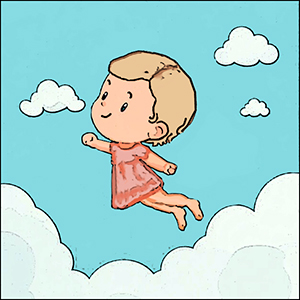
 She was the baby from the train that fell from the sky.
Did we catch her when she fell? I don’t know.
Maybe you should decide.
There were three of us. You, me, and the child. We named her Annie Beth Morningstar. We couldn’t give her much, but we gave her that name.
And I still wonder, even after all these years, why us?
Why were we the ones who caught the baby who fell from the train that fell from the sky?
The story started in the deepest winter.
First, You
Across the years, I am calling you back to remember that first night. In the smoky dark club overlooking the baseball stadium, winter howled outside the second-floor picture window, and you stood at the bar with a group, drawing the stares of any breathing male.
I was never one to just stare, even if I had to wait in line. I made my way through the crowd and simply stood in front of you. Your eyes narrowed, registering the mystery of that bold move, while I said, “You are so far out of my league, it would be an honor just for you to tell me to get lost.”
Something shifted out of range, those dancing winter winds taking the lead. I saw the smile you thought you were hiding, and with widened eyes you stared hard enough to see my future. You said, “Anybody with a line that cheesy needs work.” Your laugh was like a river running straight from your soul. “How can I tell you to get lost? You obviously need a lot of help.” We both laughed, and like an unspoken promise, everything changed.
The late-night rhythm struck a new beat. We started talking, the crowds thickened, and we slid into a kind of dance. There was a moment when your back was up against a scratchy brick wall, with your arms around my neck, and you said, “I don’t do stuff like this.” That kiss made us both forget our names. That moment erased everyone in that smoky loud room but you and me.
Then, The Accident
A week later came the accident that choked the whole city with pain. The accident and the baby on the train.
They’re called ‘El’ trains, elevated maybe two stories above the street on rusty iron superstructures that break apart every ray of sun brave enough to shine. Circling a loop of downtown Chicago, they rumble through the sky. Any human being in downtown Chicago who has looked up at the El has, at some point in their lives, asked themselves what would happen if one of those screeching steel monsters fell off the track. But no, that could never really happen.
Until it did.
At 5:23 on a rainy gray winter evening, the streets were jammed with rivers of people and vehicles. A motorman on the El paused at just the wrong moment – maybe there was a little bit of something he smoked, maybe not – and one car slammed into the back of another train. Two train cars jackknifed into the air, in slow motion, the wheels peeled from their tracks. Screams, stopped hearts, and terror blanketed souls like sweat. Glass shattered, metal twisted, bodies flew as two cars full of people tumbled over the side of the track and smashed onto the street forty feet below. One car was left hanging, jammed with terrified commuters, dangling in horror. Pointing straight down, maybe ten or twelve feet from the hard, cold street, the train car swung in the winter wind.
Ambulances lined up, engines humming, red lights strobing across the steel supports where the one train car still dangled, hanging from the sky.
Eleven people died hard deaths. The screams of the one hundred and eighty injured filled the night, crushing the heart of the city.
The hospitals ran out of beds, so they started putting people on the psych wards. Had to. No other choice. On the adolescent psych ward where I worked as a counselor, we set up cots in the day room and took in five victims. Five shattered souls who would never forget the terror of their train leaving the track and roaring out into the open air.
With no empty beds, there was no one else to claim the baby, so we took her on the psych ward. Like the first responders at the scene, those of us on the ward had no idea how the baby survived the crash. It was as if this baby could fly.
The Flying Baby
The Head Nurse, Larissa, had seen everything the street had to dish out. This was a woman who knew what the word triage meant … even she was stopped cold by the flying baby.
Since we had no cribs, we pushed two armchairs together in the nurse’s station. Aunt Sally, as we called one of our older nurses, shook her head, looked down on the child, and exclaimed, “Our own lil’ baby Jesus!” To which Larissa replied, “If that’s who this child is, then it turns out that Baby Jesus is a girl, Sally.”
The tiny stranger, looking up at the circle of heads surrounding her, didn’t seem the least bit scared. A little bruised, breathing calmly, she appeared to be eighteen, maybe nineteen months old. All of us had heard the first thing the EMT had said when he wheeled her into our ward. “But I tell you people, I did not know that babies could fly.”
The EMT continued, “She was in one of the cars that flew off the track and bounced off the ground. I found her in a pool of broken glass on the sidewalk. Smiling and gurgling. Not a single cut from all that glass. Barely a bump from the fall. More like she had just woken up from a nap. Nobody around her survived. No one. Just this one little child. As if she could fly. I swear. It was just like she could fly, slide on, and land sweetly gently on the street, waiting calmly for what comes next.”
Annie Beth Morningstar
Later that night, I called you to say I was working a double shift and wouldn’t be home until morning. I told you the story of the baby, and you asked me her name. I said no one knew, and that’s when you came up with Annie Beth Morningstar. You didn’t think about it. You said it right away. As if there was no other choice. You gave her that name. So that’s who she became.
The next morning, we had breakfast at Nookie’s. Over the eggs and sausage and coffee, we decided that you would come with me at the start of my afternoon. shift, and visit little Annie.
Later that morning, we walked back to your place for love and the only rest we could find.
When you came with me to my shift later that afternoon, we found that little Annie had been moved to the Prentice Women’s hospital on the other side of the building. You got to see her, though. I’ll never forget your face when you first saw her; you looked ready to sit down and start making plans with her.
It took almost two weeks to find the parents. They had both been seriously injured, the father was in a coma, and the mother had suffered a head injury, causing some memory loss. For those weeks, no one came forward to gather up and hold onto that little baby miracle, so, we would see her. We would see Annie every day. The nurses always let us in so we’d sit with her, sing to her, rock her to sleep. Sometimes she’d smile and look at us as if we all shared a secret. Catching her with smiles as she drifted off to sleep.
For a while she was just ours.
Up until that day her parents arrived.
I remember handing Annie Beth over to a woman I must suppose was her mother. Annie’s eyes were troubled. She gurgled and cried as she flailed, found your finger, and held on tight. She squeezed your finger, beaming you a smile, a smile that would have to do. Beyond her, the hospital room door opened, as if a train were about to board for a trip to some other distant sky.
After Annie
How do you lose something that was never really yours?
That winter, Annie’s winter, sputtered into a lifeless spring. Every corner of Chicago was painted its own shade of grey.
One grey spring morning, soon after losing Annie, we woke up at the exact same time, looked at each other, and both said, “Road Trip.”
How easy it was, back then, to just jump out of bed, slide into the car or hop over to the airport, and just get out of town. Packing was a 90-second prospect. No vitamins, medicines, lotions or potions, no preparation for weather changes. No reservations or planning the route. It was just “Go!” And if we got lost, we would just drive until we weren’t lost anymore.
Maybe our road trip was a buried cry to losing Annie. Or maybe not. We weren’t all that deep-thinking then. If some great cosmic voice from the sky spoke to us, “Do you realize this will be your last trip together?” we probably would have just turned to each other and asked, “Did you hear something?” pause a beat to laugh, and then say in unison, “Nah.”
Somehow, we knew we were driving south. How we got to North Carolina is a mystery, but we arrived at the Outer Banks. Camping amid the salty smells and sounds of the ocean, we drifted off to sleep. That’s when the rain started. Before long, it got seriously torrential to the point of scary. The tent collapsed, and we gathered up everything. Tripping and slipping and giggling in the in the mud, soaked to the skin, we ran for the car, tossed our stuff into the back seat, and started driving through the wet Carolina night. With only the rain and the empty, middle-of-the-night road, we headed for your parents’ roof three hours away, or maybe not.
For a while, we were quiet, listening to the rhythm of the wipers, and breathing in scents of the green forest rain. Turning away from me, your eyes searched among the darkness of the pine trees. Turning back to me, your eyes wide and bright as starlight after rain, you said, “Think she’ll remember us?”
I looked at you and said, “She will.”
And you answered, “We can hope.”
The original story was posted in March 2022 as The Baby From the Train. This edited version is what made it into my book, Chicago Street Corner Stories, published in late 2021. Both versions have their merits. If you read both, let me know your thoughts, thanks.


