Mar 282010


On the northwest corner of Clark and Waveland in Chicago, waiting outdoor tables at the Italian place in the golden promise of spring, she’d glance up at the scoreboard inside Wrigley Field. Just for a fraction of a moment. Because this was before they put guardrail planters around the sidewalk tables; and if someone dined and dashed, she had to pay for the meal she served.

Here at the back door of Wrigley Field, the low wall of the left field bleachers gliding up to center field and the scoreboard making all who cared to look part of all the action, would actually invite you into the park. Like a church greeter who welcomes any stranger and shows that they mean it by the sparkle in their eyes. The back door view of Wrigley Field smiled and said, “Welcome. We’re glad you’re here.”

In the spring, the gravitational pull of the baseball park where an old seminary once stood, coal towers once clambered, and street cars once clanked by in what was a border town to Chicago, drew eyes and quickened one’s breath looking up at that scoreboard. And the summer began.

And in the sunset warm days in late August, early September walking west on Waveland, one could walk out that same back door looking into the fading western sky and mark the passages of lives and times.

Once, standing in front of the old red brick firehouse, a splashing open hydrant flowing rivers of watery anticipation though the streets, we stood waiting, chatting with a cop, until the giant doors swung open and the somber black motorcade with President Bill Clinton in the middle vehicle rolled down the window, waving, grey hair glimpse and smile. “Look who came to visit us,” said the cop and allowed himself the hint of a smile.

The front door of the Park is on Addison. The flashing messages. The inscribed bricks in the sidewalk that rich people can buy. The massive throngs mostly enter here. And this is where the pictures are taken. Walk a block east past the statue of Harry Caray swinging a microphone and another statue of “Captain Morgan,” the corporate symbol of the people who make Captain Morgan rum—a statue that it’s easy to pretend doesn’t even exist—and you’ll find another entrance.

Circle around Sheffield Avenue and walk another block and you’ll find the entrance to the bleachers, a corporate entity in itself that probably grosses more than the some small countries. Walk west and you’ve circled the place, ending up again at that back door. The one where anyone can look up and be invited inside.

Wrigley Field draws 37% of its crowd from the City of Chicago. The rest come from other places. So inserting a giant sign on the outer lip of the left field bleachers that says TOYOTA won’t matter much to most of the people who come to the party at Wrigley Field. Taking a little bite from the once open invitation to all won’t matter to most. Most people, like us, can’t afford what it costs to get in the place anymore anyways.

But being shut out of the park does not mean being shut out of the game.

Baseball will be stronger than ever. Baseball has always been about memory, shared traditions, an ongoing balance between those vulnerable to loving what they can’t see and those itching to exploit that vulnerability to scratch every last penny from the cracks in the sidewalk.

Nobody is a bad guy here.

The voices of baseball will still stream from the radio, set the scene, call the game, give it color and then let it ruminate slowly in the summers of every listener’s mind.

Another door was closed. This time the back door. An invitation to come inside withdrawn. Not the first time. Won’t be the last. And there are certainly bigger problems in the world. Even bigger problems in baseball.

But the voices of baseball still stream outside what’s closed up now, stream into the larger world carried in the rhythms of the green fields of the mind. Loud and clear and so much bigger and stronger than any one person who believes they can really own them.

The view’s a little harder. But the rhythm of the game remains unchanged.

And what if this was our year?

Mar 122010
 

Insurance is best understood over an ice cream cone.

My Dad taught me that when I was 17. And like all life lessons that last, there was no grand diatribe of advice. No lessons. No lectures. You learn best not from what a person says, but from what they do. You learn from who they are.

The night I learned about insurance began, as was often the case with my Dad, with an ice cream cone. A proper beginning.

On the Green Bay Road. An old Indian walking trail connecting the Fort at Chicago with the deeper green and wild forests of Wisconsin. The echoes of native American and French traders footsteps perhaps not all that distant in a grander sense of time. During our time, a charging yellow Chicago and Northwestern locomotive pumping power down the tracks to the side of the Green Bay Road. In what was then just an average middle class town named for the Frenchman Wilmette—long before it grew to become closer to a gated community of the super rich—my Dad and I pushed out of the balmy summer night and into the ice cream excitement freeze of Hammonds. Silver gleaming soda fountain magic, mirrors and red topped silver stools that spun circles around the chilled marble counter. The tubs of wonder ice cream set out proudly.

We liked chocolate chip. And chocolate mint. Two scoops please.

I look back and wonder: Would we have the satanic trajectory of greed dressed in $2,000 suits, sporting $400 haircuts and commanding $1,000 per hour lobbyist fees all guarding the gold of the insurance status quo if everybody’s Dad took them out for ice cream cones?

I worked in an insurance driven industry for almost 10 years. I know what an actuary does. I even know why it’s important. I even LIKE people who work for insurance companies. Individual people are not the issue. It’s the system of self-perpetuating greed. A SYSTEM who never had a Dad take them out for ice cream cones.

Or take them next door to the used car lot.

That my Dad was even thinking about buying me a car was so far beyond my comprehension of the way life worked that I really didn’t know what to think, what to say and was iffy on whether or not I knew how to breathe.

I had never asked for a car. I had lusted over girls a lot more than any car. I hadn’t really thought about it all that much. I knew we weren’t rich people because I read books and watched TV. I knew we weren’t poor people because we always had enough. And my Mom did work with poor people. So I knew we weren’t poor.

But my parents were moving to the east coast. A job change for my Dad. And I was being allowed to stay. To live with my aunt in Evanston. To far to walk to where I was being allowed to finish my last year in high school. So my Dad thought a car made sense.

That’s what I mean about learning from someone who knows. My Dad always did things that made sense. So that’s what I tried to do too.

So ambling around the used car lot eating our ice cream cones, the cold keeping me out of the stunned shock of the purpose of this walk—-to buy me a car.

I don’t remember a salesman. When I was seventeen, my Dad had a quiet presence, not all that different than the one he has today, that was open and friendly to all. But it also included an underlying layer of an indefinable something that said, “Never, ever, ever, mess with this guy.” Once, when I was even younger, I remember a guy sliding his car in out of turn to steal a parking place from my Dad. The guy then got out of his car, and started to walk away. My Dad rolled down his window, looked straight at the guy and roared like a clap of thunder HEY!

The guy took one look at my Dad. Said nothing. Just walked back to his car, unlocked it. Got in, drove off and left us the parking place.

So I’m guessing the used car salesman kept his distance that night we walked on to his lot enjoying our ice cream cones. And when My Dad found a sturdy, reasonably priced old VW beetle, asked me if I thought this would work—to which I probably just mutely nodded yes—we went into the shack at the back of the lot to sign the papers.

And that’s when we found out that the insurance would cost more than the car.

“The insurance,” my Dad raised his eyebrow at the trembling salesman and very calmly said, “the insurance cost that much more than the car? I have this right?”

To which the salesman nodded.

My Dad then thanked him for his time. And he said, “Well, that doesn’t make sense. So we’ll pass.”

To which the salesman, being smart enough to not even try to overcome that objection, said, “I understand. Thanks for stopping by.”

So we walked home. The loss of the car not even scratching the surface of my teenage angst. I didn’t know then that you can’t loose something you never had. And if I had ever heard that sentence, I probably wouldn’t have known what it meant.

What I did know was how much fun it was just to go for a walk with my Dad. How in our family, we did things that made sense. That never went away.

Now all these years later insurance comes up again.

As a defining issue of our time.

On TV the slickly dressed lobbyist says, “We want to insure everyone.” And his smiling opponent speaking up for sanity says, “No, you make money by NOT insuring people!”

My wife screams at the TV, “That’s why we have 6 riders on our policy making sure you won’t insure the two of us for those 6 medical conditions. That’s WHY we have to pay more to take our prescriptions to an independent drug store so the decisions on the drugs stay between our doctors and us and the data on the prescriptions doesn’t zoom right into the insurance data bases. That’s why we have to work so hard to protect ourselves from you insurance company!!

If only we could take those insurance companies out for a walk and let them have an ice cream cone.

Not a leveraged buyout of the ice cream industry. An ice cream cone.

And then just stand there in quiet, consistent and loving strength like my Dad did all those years ago.

And simply go and do what makes sense.

Mar 042010
 

“What marvelous love the Father has extended to us! Just look at it—we’re called children of God! That’s who we really are. But that’s also why the world doesn’t recognize us or take us seriously, because it has no idea who he is or what he’s up to.”

1 John 3 “The Message”

All we really know are the clues.

That, and the wonder that they can be left with such marvelous love.

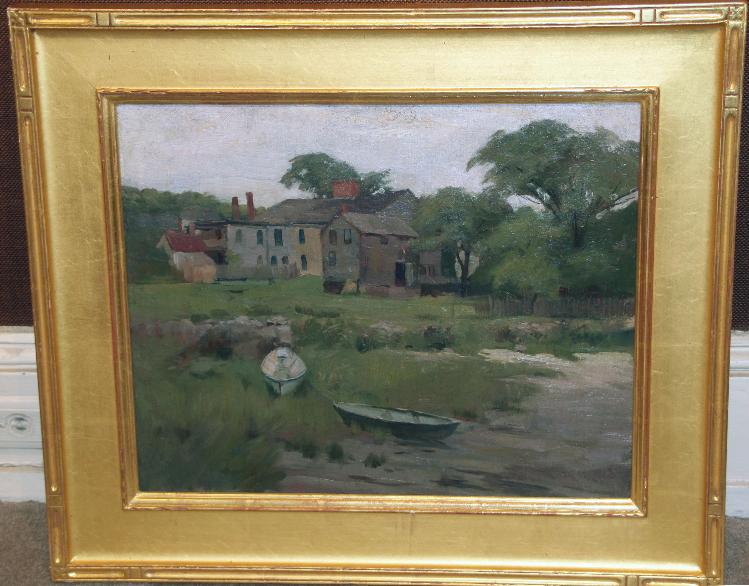
The painter leaving clues here is Arthur Wesley Dow.

The marvelous love can be seen in the way God guided his hand to fill the space on this canvas with beauty.

What marvelous love in the way the colors blend to form one world. And give us one common sky.

That common sky is a clue.

What kind of exhaling of the trials of a life took place in the homes in the foreground?

How long had the folks who lived in those homes known each other?

How many days and how many times had they looked out their windows. Saw a neighbor walking down to the swampy bay. Stopped and face to face, looking in each others eyes, got the story—and then both laughed in the common love of knowing that no one person knows the full story of whatever tiny moment of today’s pain is front and center. Laughed together to cook up some drama. But then paused, and looked up as pinpricks of pain faded in a blink in the marvelous love of that one common sky.

No one child of God knows who God is or what he’s up to.

Where had those boats been? What kind of foreign lands? What were the stories that the people from the houses told when they came back from their journeys?

What were the songs running through their minds as they pulled the boats up from the swamps and trudged up to the lights of the homes?

“The water is wide
I can not cross over
And neither have I wings to fly
Give me a boat
That can carry two
And both shall row
My love and I”

Did they see their songs as answered prayers?

Do the clues the artist leave help us make peace with all we don’t see?

Because the world has no idea who God is or what he’s up to.

In knowing we never know all of it—are even the most calcified expressions of religious beliefs accepted? If Jesus walked the dusty Afghanistan roads of death, could he really be a Chaplain in the Taliban Army?

Were the four sides of Abraham’s tent really left open so his children could enter from any side blown in by the same hot desert wind?

Are the curdling blood screams of bodies trying to stand up tall given rest? Is fear of the other stilled? When all we have to hang on to are clues?

Can we find serenity under the unified sky?

So that the marvelous love can soothe even the most savage of pains.

In better times, my wife and I would be driving through endless green fields under a great lakes sky in the empty middle of the Door County Peninsula. We’d come to a cornfield waving crossroads. Every single direction would look exactly the same. And then we’d turn to each other and say,

“All we know for sure is that we know nothing.”

Then we’d just pick a direction and drive.

And in driving through the fields, I remember the sky.

Like the unified sky the artist left us in the painting. The clue from the artist.

What marvelous love.

Feb 132010
 

Head slumped down hidden inside the scraggly beige down coat that is her only real home. She shuffles past our house walking north every morning.

No one sees her face.

Like a burned out barren asteroid with the last vestiges of a trail being unfathomable sadness; she blends with the grey winter sunrise. I have no idea where she goes everyday. But that rolling trail of sorrow reverberates out from somewhere inside the coat like a cry of stomach twisting pain that no one ever hears.

She deserves a story. At least a name. So call her Cassie. And remember that it wasn’t always like this for her. Crossing Grace and trudging silently up Hermitage, she passes the first 5 little houses, once home to factory workers, crammed full of kids. The Irish on the south side of Grace. The German to the north. The men listened for the whistles at the old Abbott Drug Plant or the Choir Robe Plant or any one of the other dozens of manufacturers that lined the train tracks of the Ravenswood corridor. The women swept the sidewalks out front where Cassie now walks.

Now these factory houses start at half a million. Still standing, some filled with frost free refrigerators unimaginable to those women who swept the sidewalks, who took a pack lunch with the kids to Wrigley Field on Sunday afternoons after church when the men could rest. Downstairs in the basements of those little factory homes; the hardwood beams from the northern Wisconsin forests still supporting these little homes, now with few or no kids.

Of the first 5 houses Cassie trudges by, 3 of the 5 men are out of work. Hard work, education, experience—especially experience—not being enough. The Abbott Plant a yoga studio. The Choir Robe factory being condos. And even cutting the grass being work that is unavailable to the people who live in these houses where the Wisconsin hardwoods anchor the passing of good times become hard times.

Cassie would know the hardwood trees where those beams started life. The forests of Northwest Wisconsin. The cherry farm off Sturgeon Bay. The winters. Sometimes when the wind blows fierce and as Cassie walks she smells the moraines left millions of years ago when the glaciers came through and sculpted the Great Lakes, the Door Peninsula shining brilliant promise in the light of bare trees, a white church on a hill overlooking a bay in a town called Ephraim.

The curve of the shoreline made splendid by the sun. Their tiny little farm, before he left for green jungles of rice paddy water and snakes on the other side of the world. The letters about the men. The way the shooting pains started in her legs, then the sharper pains, but she still kept waiting because the letters kept her going. “You’d eat what?” She’d write back. Twisted inside with the worry that he wasn’t taking care of himself. He just thought about the men.

Writing back about the men, and telling her, that no matter where they all were in that jungle, what really mattered was that “officers eat last.”

Officers eat last.

Those were the last words of his she ever read before she got the telegram.

And the farm. The little farm. No room for little cherry farms. Not anymore.

So she came to Chicago. To find work.

Like people have always come to Chicago since the time when, as the poet said, the first white visitors “slept till noon and then scolded the Indians for being lazy.”

Now in Chicago, no one with an ounce of sense would ever mistake Cassie for lazy. As the times get worse and the clouds of blame drift and wrap their smoky haze around those least able to take care of themselves, and those who have search desperately to find a way to blame those who have the least; Cassie’s daily walk is 8 miles. With leather like paper on the soles of her shoes.

At days end, Cassie’s walk back down south takes her along Hoyne Avenue. Like Hermitage, the kind of quiet street where her heavy heart can feel a trace of calm.

Passing by a cross street in the shadow of the steeple, she doesn’t know it’s the block where the man who was almost governor of Illinois lives. But something in her makes her burrow even deeper inside that down coat that she has no money to clean.

She looks left and sees the neighbors on this street talking on the sidewalks. She sees portable basketball nets left out on the sidewalks even when she walks home in the dark. Kids shoes and wagons and bicycles littering the block. Once she passed by and saw yellow crime scene tape blocking entry to the block and heard the music of the giant F. Scott Fitzgerald party bubbling out. Had she stopped to talk she would have found that were people who lived on that shining city block of money who would be kind to her. There were even people on that block who’d make it possible for her to get a meal on a Wednesday night. A good meal. Warm. There would be a piano playing hymns, same ones she remembered from back up in Wisconsin in the cherry grove church. And after she went back out into the cold city night to keep walking, there would be people from the block sweeping the floor of the meal room. Not a lot of people. The number getting smaller every day.

Cassie knew numbers. You don’t grow up on a farm, run a farm, figure seed costs, crop yields and market prices without knowing numbers.

Numbers like this: the people who live on that block in the shadow of the steeple are within the top 10% in wealth. And the unemployment rate of that group? 3%.

And the people in the lowest 10% in wealth? What percentage of them are unemployed? 35%.

On her morning trail of dry tears up north—the people she passed were somewhere in the middle. Between the 3% and the 35%.

Course nobody talked to Cassie about numbers.

Usually no one even saw her. And no one really knew her story.

So Cassie walked.

Back down south as the winter light faded on another day of hard times.

Cassie walked.

Feb 052010
 

If any hospital is like a damp green canvas supply tent perched on the edge of the universal war zone where we all do battle against the fading light of one last breath; then the Evanston North Shore Medical Complex would be akin to the General’s Headquarters. Saddam’s Golden Palace where American troops now walk the halls. The stately French villa bathed in a Monet sunrise where Patton or Eisenhower planned the war.

Under the towering ceilings and golden teak wood and marble splendor of the lobby reverberating with the unseen messages sent by money; the 3 of us walk out past a gleaming black grand piano that plays a homogenized Gershwin tune all by itself. Ghost fingers striking keys in technically correct soulless precision.

A fireplace circled by comfortable chairs and a high ticket carpet. No one sits to warm themselves by the electronically dancing orange flame. A uniformed doorman, as if this was the Ritz, professionally courteous greeting guests.

But buried not so deep beneath the sprawling mushroom bastion of red brick wealth adjoining this eternal war against the roar of illness and death; at the level where the boundaries of time disappear, comes forth the silver swinging doors and sickly sweet antiseptic smell of pain and the green painted halls that slither into a circular desk that says CENTRAL REGISTRATION.

I am 4 or 6 or 12 and in the weaving past the gurneys with IV tubes and old men with parched yellow skin and empty eyes; green smocked workers, nurses in white and holy men doctors in the gray coats; there is only the subdued hospital hum of my terror numbed by the fact that I’ve been here before.

And my Mom is with me.

Here on the edge of that battle against the dying of the light, my Mom is here. So I survive.

Poked and prodded and ripped and torn bleeding because no one knew what was wrong.

But my Mom is here with me. So I survive.

Then one day they injected a dye into my neck. The early days of X-Rays.

And then all these years later in this bleakest of midwinter days, I can still feel the searing freight train burning pain in every last capillary, every cell blazing in a screaming numb horror of hurt as the dye coursed deep into the wretched bottom of my little boy soul and burst out the top of my head splaying pain like bullets of molten hot rain.

I do not know how, but if you feel that kind of pain and then it stops; believing in things you can’t see becomes easy. Faith is a breeze. Not a stretch at all.

And my Mom was with me, so I survive.

The dye of all encompassing pain lights up the tumor inside me like a blazing firework next to that neighboring battlefield of death. Then the surgeons go to work.

My Mom and Dad walk the hospital halls, linoleum then, and hours and hours later, they walk in slow motion into intensive care, where a beeping sound tells me I have a heart. Its three days later and I survive.

I’m still here.

Now I sit in that same waiting room. The layers of money not fooling me at all. It’s still the same outpost on the edges of the death war against the dying of the light.

My wife is inside. Arthography and an MRI. Because a year of silent chronic, not one complaint,  pain is enough. A lifetime of dancing and then you have to stop. You still teach. But the hip stops you from dancing. For a year. And this time you can’t even blame the victim, because it wasn’t even the dancing that did it. It’s just the way she was made. No complaints, not a word. Just a shadow in her eyes and a bravery that runs beyond what I can fathom. Not one word, as money started draining like pus from a wound. And she bit her lip, then smiled. Till it was enough. And we’d just do it. So we found out that there would not need to be a new hip. But there would be arthroscopic surgery. So we came to that same room where I had felt the injection of the dye they didn’t use anymore.

Back behind walls I couldn’t see through; that same strain of medical arrogance as the chest puffed out doctor fumbled to hit the vein and was quiet and what was supposed to take 15 minutes took an hour. And the same cold blind institutional ignorance that said it was OK to dress her up in a hospital gown, complete ½ the procedure, and then walk her too fast across the public lobby so everyone who looked could say to themselves, “Look, there goes a patient.” She tells the technician to slow down, he does for three steps and then looses her request in the war haze of his indifferent mind and speeds up again.

But somehow. Here on the edge of this battle. She draws Nancy. And Nancy, the nurse, says to her, “You just squeeze my hand as hard as you can.” Somehow, someway a human connection, like a story, cuts through the pain and gets her thru it. God gives you what you need.

While out in the waiting room, swirling in a haze of long ago  pain mixed with a pain that cuts even deeper because the very breath of your life, your life’s love, is behind a wall in a hospital. And hospitals, sitting on the edge of that terrifying battle hurt people just as much as they help them. Hospitals can kill and maim. Never, ever, ever, trust a hospital. Especially this one.

Because in war, anything can happen.

And then, just as no book could ever be distracting enough, my eyes go wide as in through the door strolls my sister in law, laughing and saying, “Looks like the whole family’s falling apart huh?” A complete and total surprise.

Better than any birthday present I’ve ever had.

Her, with her own medical trials, gets herself a quick x-ray and then comes to sit with me and wait for her sister, my wife. Talking and sharing stories and making hours seem like seconds.

Talking and sharing stories. That’s all we did.

What if the stories were the real medicine? Here in the United States in 2010 as the eternal battle against that last breath mutates and multiplies with apocalyptic momentum into an all consuming fire to suck the very life from the will to just be healthy, or to get healthy if you’re not, what if that human connection of the story, remember that time when my Mom spent her days taking me to this hospital? When Nancy the nurse said to my wife, ‘just squeeze my hand’, when a sister in law became a friend because she stayed to wait; what if the stories were the music at the edges of the war?

Stories that could be heard like songs. Like when the poet Holly Near sang:

“The junta took the fingers

From Victor Hara’s hands.

They said to the gentle poet

Play your guitar now if you can

Well, Victor started singing

Until the shot his body down

You can kill a man

But not a song

When it’s sung the whole world round.”

What if the stories were the real medicine?

Jan 272010
 

black_cross_new_mexico_360

 Years from now, the sad eyed young woman in an orange dress, wrapped up against the Chicago cold in a blue goose down coat steps outside the Haitian Community Center and begins to walk to the water.

Every year the quiet ceremony remembering  Earthquake Day, January 12, 2010, seems to get larger. 15,000 Haitians called Chicago home back in 2010. Thousands more do now.

In the Rogers Park neighborhood, where she lives, blocks from the Center, the huddled frozen souls of the day are are just beginning to fill the streets, the rising winter sun laughing at warmth. The woman offers up a tiny smile wondering if the tropical sun of the first 14 years of her life had warmed her bones enough to make it through all the rest of her coming winters.

Somewhere she remembers fragments of that  day in 2010. The sweet, acid smell of death in the rubble of the streets. The pleading of the dogs. The piercing eyes of the rats. How she always seemed to be thirsty.

Seeing the giant ships steaming into the harbor. And then the clatter and confusion of all the different languages. Fire trucks that said Fairfax County Virginia, the honey toned drawl of the women and men inside. The sharp staccato voices of search and rescue crews with NEW YORK stenciled on the back of their shirts, a nurse wearing a blue baseball cap with a red C, just like Sammy Sosa, barking out orders in tones as flat as the mid western plains she had ridden through in the bus that brought her to this land of dancing snow.

Truth told, she’d often giggle when the snow came. Something about the snow she just didn’t quite believe,

 If you were to ask her right that moment how she got here? How she made it when so many thousands did not? She’d never be able to answer. Because she really didn’t know. So much of the months that followed after the day in 2010 being blank. So much she didn’t know.

As she walked down to the water, the icy steam from the giant Lake Michigan rising on that future January 12, she remembered her Grandmother back in 2010.

First the earth began to tremble, the beams of the old hotel came down crashing, her grandmother trapped, her ancient Caribbean eyes still strong looking head on into the very soul of the little girl gripped in fear and saying to the child: “Always remember child, you were loved. Always remember you were loved.”

Now at the shore of the Lake. Back to her present time. She brushes snow off the bench and sits down. Today she will not be at work. Today her kids will have a substitute teacher.

A teacher. How can a woman with so many holes in her memory be a teacher?

The answer is that the drawings from the kids on her refrigerator at home, the notes from parents, and the smiles on the kids face when they come into her room in the morning, little kid sighs of safety, all of those things  tell the story of what kind of teacher she’s become.

Her, a woman who still can’t remember so much.

A blast of icy wind swirls down across the beach from the north, and she digs out of her pocket a journal and a golden pen. She remembers the music played at the ceremony. Strange music. Not Haitian at all. A piece called Cavatina. But something happened when she heard it. Something shifted inside.

She looks at the pen, puts it to paper, remembers the music and begins to write.  She begins to tell her story.

“My grandmother’s name was Elizabeth. She wore a ring

speckled with real gold. And sometimes after dinner, we’d be

sitting out on the porch, I’d hear the sound of the wind in the

palm trees—and she’d let me take a turn wearing that ring.”


Sep 222009
 

[youtube=http://www.youtube.com/watch?v=8aYAUE6is7I]

The tent had collapsed in the blistering rain of the Outer Banks. Miles from any kind of light but our own and we just couldn’t stop laughing. Neither of us having any business setting up a tent.


Piling all our soaking stuff into the back seat. Didn’t take very long. We didn’t have very much. And then still laughing, driving through the night green soaked North Carolina forests. Back to your parents house in Chapel Hill. And if the ride were to take forever, that would be OK. The rain, the windshield wipers the tires gliding down dark deserted pavement through the trees.


And because we both knew every word to every song, we thought the ride might last forever.


Mary Travers sang: “Follow me, where I go. Who I am and what I know. Make it part of you, to be a part of me.”


Then when she sang “Though the cities start to crumble, and the towers fall around us, the sun is slowly sinking, and it’s colder than the sea” —-we thought we knew big thoughts and would do big things. There was no horizon to possibility. The night time North Carolina road went on forever.


Mary Travers, not just singing with Peter and Paul, but giving voice to us in that car, in that rainstorm, when she sang, “Any day now, any day now, I shall be released.”  We thought we knew what that song meant too. And maybe somewhere deep we both did. Maybe that’s why we both laughed in the rain when the tent came down.


Mary Travers gone. So is all our laughing innocence.


But Mary leaves us her song. And we remember the words.

Sep 112009
 

001_1


Was that us?

 Running through cool sand under 2:00 a.m. starry skies, clothes tossed along the way splashing into the sea then diving under the waves and coming up laughing shivering joy.


Was that us?


Not this time.


Aunts and Uncles, Moms and Dads, families you were born to, families you choose, all tucked away in the borrowed beach house rooms along the Jersey shore while the kids raced the sands and rode the waves.


Once it was us. Crashing the waves, or traipsing big city neon streets or even standing in your very own kitchen polishing off a bottle of really good tequila.


And now as it becomes the kids, the no-longer are they kids, kids—time stops. And it’s all just this one golden moment on the beach.

Aunts and Uncles, the chosen or the related kind, know the moment well. Because it’s those moments that are the crystal polished beaming diamond of what you get if you are one of those aunts or uncles. Aunts and Uncles are in it for the sprint. The moment

Looking around at the parents, those, unlike me, blessed with kids, they are in it for the marathon. The long haul.


Then what happens at the wedding is that both the sprint and the marathon come racing towards a finish line together.


And that’s when the time stops.


Seems like just a moment ago it started.

Now I stand on my sister’s porch, listening through the window, and hear that long gone little boy in the picture say to my father, “Bud, would you like me to help you carry that luggage?” And of course my father answers, “No, no, thanks Ben. I’ve got it.”


And Ben answers, “Well, I’m going to help you anyway.”


And just like that: the little boy is gone. Somehow in his place, a wandering, born to heal soul of that no one would ever mistake for anything other than a man.


Sokyo and Ben came together traveling India. In tiny villages, along quiet roads where there are no tourists. In teeming, ancient cities he once heard her laughter inside a building 1,000 miles and months since the last time they met. Circling Asia, he told me, they later found other times and places where their paths had almost crossed again. Places they stayed where they would both look out separate windows and see the exact same view.


Brides are the stars of any wedding. But this one kicked it up a notch.

The invitation was her freehand drawing of every single wedding guest. Drawing she did from photographs. The night it arrived at our house, I opened it up, thought “That’s nice.” But then my wife said, “Wait a minute. Look at this. There’s US! Sitting at that table!” And then proceeded to study this tiny masterpiece for about ½ an hour. Ben had hand scripted names to fold over each face or figure, so there was even a program to identify all the players.


Uncles keep a respectful distance. Both in watching the preparation for the ceremony in the church across the street. And at the wedding itself. 


Watching this bride glide from Korean flower arranging that rang of timelessness; to the preparation of the Indian food. And then suddenly Ben would walk by and she’d jump on his back and off they’d go laughing like two smiling young trees in the wind.


A snapshot at the wedding dinner. The 90 year old matriarch, Ben’s English Grandmother, goes to sit with Sokyo’s mother Mrs. Kim. Neither speaks the others language. But they talk and smile, pat each others arm, they laugh and nod their heads. And then, and only then, the bride sees them talking from across the room, walks through the crowd to just them, kneels down between the two women from different ends of the earth, holds both their hands and translates.


At the cake cutting, the bride doesn’t just make sure her husband’s face is covered with cake; she cuts pieces and goes and plasters them all over the faces of each of her bridesmaids in once again another explosion of laughter.


Then another gift to every single person in the room. All of the bridesmaids and the bride’s mother, Mrs. Kim, get up and sing a traditional Korean folk song. And there is no need at all for a translation. The sweet lilting harmony cascading like a waterfall joining the world. No translation necessary. Just a sweet song of joy.


When it’s time for the first dance, the bride and groom, both dressed in traditional Korean garb, he with billowing pants and a puffy pirate shirt, she in a lovely multi-colored Korean robe and red dots on her face, take to the dance floor—and perform the Rickey Gervais dance from the TV show “The Office”

Imagine this dance done step by step by two poker faced newlyweds in traditional Korean dress. Neither breaking a smile until it was done.


And then again comes the laughter.


The aunts, uncles, mothers and fathers now in the darkness around the dance floor; time stopping again for that entire room as all the flames of thanksgiving love and joy and heartbreak and separation and all that time and all that distance all converge in pools of what might have been, could have been and then somehow push back to what is. Back to right now.


The next day brings Ben riding a bicycle in the late summer sun, waving, saying, “Guess I best get to the bank or pack or something. We’re going to Peru tomorrow.”


That night there is pizza and Mrs. Kim cooking up something that simply tastes like it could sustain a person’s very soul. I dish myself some from the bowl on the table and she shakes her head a vigorous “No!” pulls me over, digs in to the bowl with her chop sticks and gives me 3 times as much —then she smiles and nods her head quickly, as do I.


The bridesmaids, Mrs. Kim and Sokyo present Ben’s grandmother with some small decorative Korean art. “Grandmum.” Says Ben, this is paper made the way it was made a thousand years ago.”


Then they sing the acapella song again. This time the words are passed around and I remember the first line was:


“It is no accident that we meet.”


That night the airport runs to Newark and JFK begin. Giant white whale international airliners arcing up into higher skies bound for Heathrow and Manchester and Seoul.  Snappy little domestic flights board for Chicago and North Carolina. Mini-vans wind there way up the coast to Boston and down to DC.


And I remember one more snapshot. Right after the Ricky Gervais dance, just for one golden instant, that kind of moment that an Uncle or Aunt can treasure most, the song below came on, a part of their music mix. It was quickly turned off. Not loud enough. Or new enough. Or something.


But as this song plays in my head and our little flight glides up and points back to Chicago, I think:

Will you look at that?  Maybe it was just for a moment. But was on their mix. They put it there. One of our songs. Written and sung by a blind man who I bet more than once has felt the warmth of an Asian sun on his face. A song that said: I’ll be loving you always.


What a gift they gave us with their wedding. Letting us stop time for just a moment and ask ourselves.


Hey. Was that us?


Sep 112009
 

LPSnow


Let’s invite them all to the apartment for Thanksgiving. The first one they missed. That Thanksgiving we had when we were all so very young.


All of them who flew from the crumbling towers and the dust and the smell of chalky death. All of them who slammed into the Pennsylvania field. All of them who burned to fiery fear in the five sided building.


Let’s invite them all to share that turkey dinner, in the bright yellow kitchen. Sitting at that tiny round table while it snows and the Chicago wind howls. Pour a little wine. Pass the turkey and the stuffing.


There will be enough.


I know it might get crowded. Spill out into the living room. Cheap pine stand for the record player. Bookshelves and rocking chair. Bathroom where your Wella Balsam shampoo beaded wet in the shower next to my cheap young boy shampoo. And then the bedroom. Then the bedroom.


I know it might get crowded. But in the golden sparkling sight of you across the room, that power you have to help me keep my feet on the ground, in your laughter like a song of a healing balm in Gilead: I’m sure we’ll find the room.


Then when all the years pass. When we remember how we helped dish out the meal that Thanksgiving, without a clue as to where it came from, how it was cooked or why that turkey ended up tasting just so good; we will both remember —wasn’t that a time?


Our guests all fed. A poet from that crowd we helped feed will whisper “Lost, by the wind grieved ghost, come back!”


But the courses have been set. Decisions made. And our guests have all moved on.


Happy with the turkey. Laughing with the wine.


By then we’ll both know, what we didn’t know then. We’re a part of a story that started long before us and will go on when we’re gone.


Come the end of the meal—on any given day—will come new songs. The mischief and the grin in a wondrous little girl’s eyes. Then stories like rewards at the end of hard long days.


We will remember all of them, remember all of them we tried to feed that first Thanksgiving.


We will set some more places at a table of tomorrow.


And try once more to feed the world’s lost souls taken way too fast.


A smile turning sad for just a moment. But it passes. Just like a boat. That can carry two.


There is lots more work to do.