Killed for Toothpaste and Crayons

The first report of his death left out the crayons.

On a gray Saturday morning in May, the man ran out of the CVS drug store in Chicago’s Little Village neighborhood with a stolen tube of toothpaste and was killed by a store employee out back in the alley. The death was ruled a homicide.

At first, nobody mentioned that he also stole a box of crayons.

Toothpaste, I understood. When scratching out survival from the streets becomes what you do everyday; you can make it without toothpaste.

When the choice is beans or toothpaste; beans would win. It’s not a pretty choice. But it is the choice.

Talk to somebody who either lives on the street or is just steps away—a group that grows larger by the hour– and most of them have pretty bad teeth.

Most, but not all, Food Pantries don’t offer toothpaste. So the groaning brittle safety net of how we all take care of each other, pretty much lets teeth slip through to shatter on the cement, a lot like the man killed Saturday in the drug store alley.

Toothpaste was covered in the story. But they left out the crayons.

The man, Anthony Keyser, a 35-year-old unemployed barber, was held down by three people and choked to death by a fourth.

Retail is a brutally hard business. There was a time, gone now, when it served as a huge part of that safety net that kept people alive because there were jobs in retail for people who couldn’t find jobs anywhere else. It still does that a bit, but the industry now groans under the staggering weight that there simply aren’t enough jobs.

Standing in line at the local Trader Joe’s Grocery Store to fill out a job application, in front of me was a man whose last job was Vice President of a Bank. In back of me, a man whose last job was as a Senior Brand Manager for a food company whose cheese you’ve undoubtedly enjoyed.

Connecting the three of us while we waited, I told them that I was a former Vice President of a national Customer Service and Training operation. I knew the human factor in business operations, so maybe between the three of us we could start a company.

But that didn’t happen. We filled out our applications, but the retailer was full.

Beyond being part of that fraying social safety net, retailing is also a tremendously sophisticated, vibrant and creative business—it’s how goods and services get in the hands of the world.

Done well, it’s fun. Something worthy of pride for a myriad of reasons. Resting on tried and true operational principles known by every front line worker, supervisor, manager, district manager, store trainer and executive.

Principles often handed down in training where retailers don’t have time to overcomplicate the rules, so those “Principles” often come down to things like: “If somebody tries to rob he place, give ‘um the money. Don’t be a hero.”

Of course, thinking back on every time I’ve ever heard that little piece of advice or spoken it to someone else, no one’s ever mentioned crayons.

Retailing is also about detail. Big ideas don’t help of the shelves not stocked and faced and the light bulb is burned out.

And I wonder if the detail left out of the original reporting, that the man was also killed for stealing crayons, is really at the heart of this story.

Moralizing, blaming and judgment all come so easy here.

Then comes the politics of fear mongering. Dredging up that unspoken fear shared by all. That cutthroat fear that says, in the shrill voices of those who make a decent living exploiting this fear: What you now have will be taken away from you.

But what if the blaming and the fear mongering wasn’t the point.

What if the crayons were the point?

The crayons and the name of the child for whom he stole those crayons.

If there was a child, what happens to that child now?

Posted in Uncategorized | Comments Off on Killed for Toothpaste and Crayons

A National Writers Project for 2010

“And you are? . . . . .” asked the first of what looked like many receptionists standing guard on the outer reaches of the Oval Office of President Barack Obama.

It was raining hard in Washington DC. I didn’t have a power broker raincoat, so my only good suit was soaked in all the worst possible places.

And I needed a drink of water really badly.

“I’m ah, um. . . Chicago Guy.”

“So is pretty much every one else around here now,” said the receptionist over the top of her glasses. “Unless of course they are “Chicago Gal. What we need to do is for you to tell me your name, young man.”

“Chicago Guy really is my blogging name” I answered—too scared to speak in anything but my very most earnest tones. Much less give a straight answer.

“Ah. I see. Well, perhaps we should call Mr. Emanuel. The President is extremely busy today. If you’ll have a seat I’ll. . . . oh here he is now. Mr. Emanuel sir, this gentleman says he’s here for the one hour lobbying session with the President.”

Rahm Emanuel stopped, swiveled and stared.” Do I know you?”

“Well, no sir. Not really. I mean, I do live down the street from you back in Chicago. But no, you don’t really. . .”

“Wait a minute. I remember talking to you and your wife when you walked past my house She’s a ballet dancer right? “

“Yes sir, and..”

“Also took from Joel Hall Dance Studios, same place I did?”

“Well, she teaches there now.. “

“Yeah. Ok. So the reason for this little visit?’

“I was sent by . . . . ..

“Ah huh. Yeah well, we don’t want nobody, nobody sent.”

“Well sir, this won’t take long. See I won this contest kind of thing. “If you had one hour to lobby the President on anything, what would it be?”

“Well, I can tell you one thing, the President doesn’t have an hour to listen to anybody on anything.”

“Ok, I can do it in half an hour.”

“Hey, you are from Chicago! Ok. What’s your topic?”

“Writers”

Writers? You mean like education? Or NEA grants or something?”

“No, writers. I’m here to lobby for writers.”

“Ok. I’ll give you 15 minutes. Let’s go.”

And before I could draw another breath I was in front of the President. Who actually smiled at me like he knew me!”

“Cubs or Sox fan?” he asked me.

“Baseball fan sir.”

“Hah!” said the president. “Nice answer! Wrong answer, but nice one.” Now, what we got?”

“Mr. President I’m here to ask you to consider reviving the Federal Writers’ Project.—a key piece of Roosevelt’s WPA—and an ideal piece of strategy for supporting your plan to stimulate the economy.”

“Well, laughed the President. Believe me, I know most writers have it pretty tough these days. But we do have grants. But help me with the connection to economic stimulus here?”

“Well, I guess I’d start with this picture,” I began.

“Ah, the Grand Coulee Dam.”

“Yes sir. A direct historical precedent to your plan to rebuild our infrastructure. Building it put 2,000 men to work. Putting people to work just like you plan to do.”

“Impressive project,” said the President.

“Yes sir. As you know, it was one of the first times that employee health care became a factor in a job.”

And who got these jobs? Asked the President

They were mostly white males sir. But they weren’t all white males. American Indians from the Colville Reservation were also hired, as were African Americans.

Well, if you’re here to convince that it was a good idea—I already know that.”

No sir, I’m here because of the connection just ONE of those 2,000 men had with the project. Just one man.

Looking at what he did shows us a way to connect writers (and eventually all artists) with the infrastructure and economic recovery you’ve trying to build.

I continued. He was a sign painter, songwriter from Okemah, Oklahoma. The Bonneville Power Administration hired this writer to do a month’s worth of work. They paid him $270.00. He wrote 26 songs.

If I may include 2 examples of his lyrics?

“I’m listening,” said the President.

Green Douglas firs where the waters cut through
Down her wild mountains and canyons she flew
Canadian Northwest to the oceans so blue
Roll on Columbia, roll on

Other great rivers add power to you
Yakima, Snake, and the Klickitat, too
Sandy Willamette and Hood River too
So roll on, Columbia, roll on

Tom Jefferson’s vision would not let him rest
An empire he saw in the Pacific Northwest
Sent Lewis and Clark and they did the rest
So roll on, Columbia, roll on

At Bonneville now there are ships in the locks
The waters have risen and cleared all the rocks
Shiploads of plenty will steam past the docks
So roll on, Columbia, roll on
And on up the river is Grand Coulee Dam
The mightiest thing ever built by a man
To run the great factories and water the land
So roll on, Columbia, roll on.

“Woody Guthrie.” said the President. “Let me hear one more.”

Now the world holds seven wonders,
That the travelers always tell

Some gardens and some towers, I guess you know them well.

But now the greatest wonder is in Uncle Sam’s fair land

It’s the big Columbia River and the biog Grand Coulee dam.
She heads up the Canadian Rockies where the rippling waters glide

Comes roaring down the canyon to meet that salty tide;
From the big Pacific Ocean where the sun sets in the west
It’s the big Grand Coulee country, in the land that I love best.

In the misty crystal glitter of the wild and windward spray
I fought the pounding waters and met a watery grave,
When she tore their boats to splinters and she gave men dreams to dream
On the day the Coulee dam was crossed by the wild and wasted stream.

Uncle Sam took up the challenge in the year of thirty three
For the farmer and the factory and all of you and me
He said, “Roll along Columbia, you can roll down to the sea
But river, while you’re rambling, you can do some work for me.

So sir, I finished,” Imagine we rebuild the infrastructure of the country

Who will tell the story? Do you really want it written down and recorded with power point?”

“I hear,” the President smiled. “That power point makes you stupid. And I understand that Woody Guthrie did really did connect the infrastructure to art. But he was just one man. That all you got for me?”

“Well sir, there were 48 guidebooks written.

One for every state. Books that were both practical–telling how to get from one town to the next. But they also spoke to the history, the stories of the state.

Here’s one that was done for California .

The detail is so rich it practically jumps up off the page.

Speaking directly to the President I said,

Imagine he story of your stewardship of our great country being told not in “spin” driven bullet points; but with the richness of true story tellers. True writers who can bring the music to the words just like Guthrie did.”

“Who wrote these books? Who were the writers of the Federal Writers Project?” asked the President.

“People like Zora Neale Huston.”

There was a lot more than state guides produced. She wrote this:

“Who else?”

Well, Saul Bellow. He wrote for the FWP. Nelson Algren, Richard Wright, Malcolm Cowley.

Ralph Ellison began writing “Invisible Man” while he was working on the project.

Studs Terkel, Rexroth, Patchen. Jim Thompson in Oklahoma.

Remember: these were NOT big name writers at the time. They were writers of immense talent who—like everyone else–needed jobs.

It was here. In the Federal Writer’s project, that Studs Terkel began what would eventually become his life long work of telling the story of our history in the voices of everyday, working Americans.

Which brings us to right now. Today. With no one writing the history of our times in the voices of ordinary Americans. No one connecting our challenges and pride through the common social themes that unite us all. No one to tell THEIR stories of what unemployment, education, hunger, health, arts, culture, innovation and growth mean in real peoples lives. No writers.

So what would something like this cost?

We could do it for very little sir. Easy.”

“We?”

“Yes sir. As fate would have it—I actually have experience at running a national organization in the private sector. Managed a P/L; employed hundreds of folks.”

“What did you do?” asked the President.

Training and Customer Service.

“I like that,” said the President. “Training and Customer Service.

Kind of sums up what we do here.”

“I found it all came down to stewardship sir. Taking care of something bigger than we are. What about people? Asked the president. Who will the writers be?

That’s the easy part sir. There are a lot of writers. The creativity would amaze you.”

“I am expecting you to amaze me.” Said the President. Now how much would something like this cost?”

“”Well, that depends on how good we wanted it to be.”

And for the first time, Rahm Emanuel spoke up. “Cut the crap Chicago Guy. Will this primarily be financed by partnerships with organizations? I mean, if you publish a book for a corporation on their corporate social responsibility, shouldn’t they pay for it? And if a Food Pantry or a Youth Services Project wants a book they can use for fund raising, one that will give them a return on their investment—shouldn’t they pay for it? Hmmm???

Well yes but start up costs. . . I stammered.

He looked at the President. Two million. That’s enough. And you put it back in donations to the NEA in 5 years when you’ve got at least 3 best selling books. And we’ll let you work out of some old offices we have in Chicago.”

If we had 3 million. . .I began

If you had nothing, Emanuel smiled. But we do have an office you could use in Chicago. And you could start tomorrow.

“No, said the President.

Start now.”
Posted in Uncategorized | Comments Off on A National Writers Project for 2010

Chicago’s Harlem Globetrotters

When they circled the chain link fence around the old brown ramshackle house across the street, a preparation for the demolition to come, I could still hear Brother Bones whistling “Sweet Georgia Brown,” and remember that mixture of laughter and awe watching the Harlem Globetrotters on the black and white Zenith in the basement when I was 10.

That house. Right across the street on Hermitage Avenue, was where Abe Saperstein was living that cold January morning in 1927, when he got up and took his basketball team—the Savoy Big Five—60 miles west of Chicago, deep into the fields and farmlands, to the tiny town of Hinckley Illinois, for their first road game. Saperstein was just a bit over 5 feet tall himself. He was twenty four years old.

And he thought that the name “Harlem Globetrotters” would sell more tickets than “The Savoy Big Five.” He was right. The man did have a vision.

For that first trip out into the frozen Illinois tundra, Saperstein collected $75.

The team played 150-175 games a year during the last economic depression, the one in the 1930’s. They got so good, that they started developing comedy routines on the court.

Saperstein was the force behind the team for 39 years. He died in 1966. By then, the team had played in 87 countries

Now, 44 years after his death, his old house is coming down.

Not a big deal, I guess. Houses along Chicago streets come down every day. Used to be that a bigger, better—and often more pretentious—house would rise up where the old one stood. A “McMansion.”

But that’s changing. No one can afford to build a house here anymore.

Now what happens, and it’s happened 3 times on our one block alone, is that because there is a thin sliver of the population that still has lots of money, the guy next to the old house buys it, (at a rock bottom price) knocks it down and presto, there’s a neatly manicured green grass blanket of a side yard for kids and summer parties.

So the very nice people next door to the Saperstein place will have a lovely big yard.

Maybe they’ll keep the historical marker that said Abe Saperstein lived here.

But what I’ll remember is the total awe in watching the Globetrotters. How laughter burbles out of a young kid the first time they recognize what it means to be so good at something; that you can make it funny. To have the command that takes fun one step further so that it even becomes funny.

The list of professionals who played for the Globetrotters is the stuff of legends. It even includes Chicago Cubs pitcher Fergie Jenkins and St. Louis Cardinals pitcher Bob Gibson.

The Saperstein house is gone. But if you listen real hard you can still hear Brother Bones whistling “Sweet Georgia Brown.”

And if you think about The Globetrotters, perhaps you’ll recall a time when something or someone had such command, was just so good at what they did; that all you could do was laugh.

Being just so good, that you laugh.

Thank you Mr. Saperstein and your wondrous team.

Posted in Uncategorized | Comments Off on Chicago’s Harlem Globetrotters

God’s Red Vespa Motors Up Grace Street

Sky seemed a bit dark today. Maybe rain. So I really didn’t think I’d see him.

Haven’t seen him in awhile. Early each morning. Perched on a red Vespa motor scooter motoring east into the rising sun splashing daylight through the trees on to Grace Street.

A plump older gentleman in a faded leather bomber jacket. Grey beard. Grey curly hair spilling our from under a Cubs hat. Eyes like the Buddha.
I never really got a nod from him. But I do think he noticed me trudging along this same path each morning. Walking west past the old red brick factory that’s now a yoga studio and a call center. Then under both sets of train tracks to slide the quarters in the newspaper boxes up on Lincoln Avenue.

A few years back, there was a stunningly well-written and acted TV show, on for about a minute, called Joan of Arcadia. God would appear as a punk rock, nose pierced teen, a janitor at the high school, a dusty homeless guy sitting on a bus stop bench. Then he’d talk to the teenage Joan and show her the way.

The gentleman on the red Vespa scooter was always moving–so I never really expected him to say anything. Much less show me the way.

But I always had thought “What if that was God?”

Yesterday, I might have seen a friend of his, but I’m not sure. Here’s how it happened. After another long morning of trying to reach inside my computer and pull out some stories, I hopped in the car and drove over to Broadway searching for nourishment in the sparse shelves of what we used to call a “Bookstore.”

Walking by a storefront lost in memories from way back when that same store was another long gone bookstore and I was a clerk. Counting out the cash drawer one morning when I felt the iron cold barrel of a gun at my temple.

“I work here.” I stammered out to the cop.

“Your alarm went off,” he growled back.
”
Officer, we don’t have an alarm.”

“Isn’t this 2927? ” he asked.

“No, this is 2947 . . . ”

Lost in that memory, I didn’t notice the guy who stepped in front of me and said, “Excuse me sir”

He then told me a story of such dizzying complexity it was like riding a roller coaster through a splashing river in a house of mirrors. He and his partner were from Springfield. They had locked their keys in the car, they’d been walking since dawn and on and on and all he needed was $4.95 to get the train ticket back home.’

It was a con. But he told it so well, with such conviction, that I said, “I can’t give you $4.95. But I can give you a dollar.” The depth on the story alone was worth a dollar.

So he thanked me with no real thanks in the tone—and I thought, “Now why did I just let myself be conned like that?”

And that’s when the gentleman on the red Vespa came to mind.

I wondered if the con man knew the gentleman on the red Vespa.
Sometimes, in the morning, when I’d open the door to our house, newspapers in hand, I’d smell the coffee, and announce to my wife “Well, I saw him!”
“God on the motor scooter?” she’d ask.
And I’d say “Yep.”

But I sure wish I’d see him again some morning on my daily morning walk to get the newspapers—especially since so many, many people I Know are playing with pain.

Playing with pain. That’s a phrase I never took beyond the boundaries of sports; until my wife said something to me 10, 12 years ago soon after we first met. She told me she had a headache. I asked her how long she’d had it—because she seemed fine to me.

And her answer was “Oh, since I was about nine. . . .”

“Continuously???”

“Sometimes it seems that way.”

There was no complaint. Not even a trace. She just got headaches.
Lots of people play with pain. Maybe even all of us. But maybe, just maybe, maybe THIS year when all the screeching rage thrown at heath care, all the anger, all the circus con men misdirection, all the blowhard rage on having it done wrong, done at the wrong time, for the wrong people for the wrong amount of money, a fortress of complexity supporting the rage while the thirty pieces of silver is counted out slow and dribbled out to so many sweaty fat waiting palms; maybe when all that is done, there will be less of us playing in pain.

Maybe there will be newly opened eyes to the bullies patrolling the playgrounds, all of the playgrounds, from Vegas to the statehouse to the boardrooms to the streets. Bullies looking only for the momentarily vulnerable — and we are all momentarily vulnerable—to snatch and grab anything they can.

It was dark this morning. So I didn’t see him on the red Vespa.

But I did read this:

The Lord will fight for you, and you have only to keep still.

So I walked as quietly as I could down Grace today.

And I believe I heard the sound of that motor scooter in the distance.

Perhaps I heard it coming our way.

Posted in Uncategorized | Comments Off on God’s Red Vespa Motors Up Grace Street

Closing Wrigley Field’s Back Door


On the northwest corner of Clark and Waveland in Chicago, waiting outdoor tables at the Italian place in the golden promise of spring, she’d glance up at the scoreboard inside Wrigley Field. Just for a fraction of a moment. Because this was before they put guardrail planters around the sidewalk tables; and if someone dined and dashed, she had to pay for the meal she served.

Here at the back door of Wrigley Field, the low wall of the left field bleachers gliding up to center field and the scoreboard making all who cared to look part of all the action, would actually invite you into the park. Like a church greeter who welcomes any stranger and shows that they mean it by the sparkle in their eyes. The back door view of Wrigley Field smiled and said, “Welcome. We’re glad you’re here.”

In the spring, the gravitational pull of the baseball park where an old seminary once stood, coal towers once clambered, and street cars once clanked by in what was a border town to Chicago, drew eyes and quickened one’s breath looking up at that scoreboard. And the summer began.

And in the sunset warm days in late August, early September walking west on Waveland, one could walk out that same back door looking into the fading western sky and mark the passages of lives and times.

Once, standing in front of the old red brick firehouse, a splashing open hydrant flowing rivers of watery anticipation though the streets, we stood waiting, chatting with a cop, until the giant doors swung open and the somber black motorcade with President Bill Clinton in the middle vehicle rolled down the window, waving, grey hair glimpse and smile. “Look who came to visit us,” said the cop and allowed himself the hint of a smile.

The front door of the Park is on Addison. The flashing messages. The inscribed bricks in the sidewalk that rich people can buy. The massive throngs mostly enter here. And this is where the pictures are taken. Walk a block east past the statue of Harry Caray swinging a microphone and another statue of “Captain Morgan,” the corporate symbol of the people who make Captain Morgan rum—a statue that it’s easy to pretend doesn’t even exist—and you’ll find another entrance.

Circle around Sheffield Avenue and walk another block and you’ll find the entrance to the bleachers, a corporate entity in itself that probably grosses more than the some small countries. Walk west and you’ve circled the place, ending up again at that back door. The one where anyone can look up and be invited inside.

Wrigley Field draws 37% of its crowd from the City of Chicago. The rest come from other places. So inserting a giant sign on the outer lip of the left field bleachers that says TOYOTA won’t matter much to most of the people who come to the party at Wrigley Field. Taking a little bite from the once open invitation to all won’t matter to most. Most people, like us, can’t afford what it costs to get in the place anymore anyways.

But being shut out of the park does not mean being shut out of the game.

Baseball will be stronger than ever. Baseball has always been about memory, shared traditions, an ongoing balance between those vulnerable to loving what they can’t see and those itching to exploit that vulnerability to scratch every last penny from the cracks in the sidewalk.

Nobody is a bad guy here.

The voices of baseball will still stream from the radio, set the scene, call the game, give it color and then let it ruminate slowly in the summers of every listener’s mind.

Another door was closed. This time the back door. An invitation to come inside withdrawn. Not the first time. Won’t be the last. And there are certainly bigger problems in the world. Even bigger problems in baseball.

But the voices of baseball still stream outside what’s closed up now, stream into the larger world carried in the rhythms of the green fields of the mind. Loud and clear and so much bigger and stronger than any one person who believes they can really own them.

The view’s a little harder. But the rhythm of the game remains unchanged.

And what if this was our year?

Posted in Uncategorized | Comments Off on Closing Wrigley Field’s Back Door

Insurance and Ice Cream Cones

Insurance is best understood over an ice cream cone.

My Dad taught me that when I was 17. And like all life lessons that last, there was no grand diatribe of advice. No lessons. No lectures. You learn best not from what a person says, but from what they do. You learn from who they are.

The night I learned about insurance began, as was often the case with my Dad, with an ice cream cone. A proper beginning.

On the Green Bay Road. An old Indian walking trail connecting the Fort at Chicago with the deeper green and wild forests of Wisconsin. The echoes of native American and French traders footsteps perhaps not all that distant in a grander sense of time. During our time, a charging yellow Chicago and Northwestern locomotive pumping power down the tracks to the side of the Green Bay Road. In what was then just an average middle class town named for the Frenchman Wilmette—long before it grew to become closer to a gated community of the super rich—my Dad and I pushed out of the balmy summer night and into the ice cream excitement freeze of Hammonds. Silver gleaming soda fountain magic, mirrors and red topped silver stools that spun circles around the chilled marble counter. The tubs of wonder ice cream set out proudly.

We liked chocolate chip. And chocolate mint. Two scoops please.

I look back and wonder: Would we have the satanic trajectory of greed dressed in $2,000 suits, sporting $400 haircuts and commanding $1,000 per hour lobbyist fees all guarding the gold of the insurance status quo if everybody’s Dad took them out for ice cream cones?

I worked in an insurance driven industry for almost 10 years. I know what an actuary does. I even know why it’s important. I even LIKE people who work for insurance companies. Individual people are not the issue. It’s the system of self-perpetuating greed. A SYSTEM who never had a Dad take them out for ice cream cones.

Or take them next door to the used car lot.

That my Dad was even thinking about buying me a car was so far beyond my comprehension of the way life worked that I really didn’t know what to think, what to say and was iffy on whether or not I knew how to breathe.

I had never asked for a car. I had lusted over girls a lot more than any car. I hadn’t really thought about it all that much. I knew we weren’t rich people because I read books and watched TV. I knew we weren’t poor people because we always had enough. And my Mom did work with poor people. So I knew we weren’t poor.

But my parents were moving to the east coast. A job change for my Dad. And I was being allowed to stay. To live with my aunt in Evanston. To far to walk to where I was being allowed to finish my last year in high school. So my Dad thought a car made sense.

That’s what I mean about learning from someone who knows. My Dad always did things that made sense. So that’s what I tried to do too.

So ambling around the used car lot eating our ice cream cones, the cold keeping me out of the stunned shock of the purpose of this walk—-to buy me a car.

I don’t remember a salesman. When I was seventeen, my Dad had a quiet presence, not all that different than the one he has today, that was open and friendly to all. But it also included an underlying layer of an indefinable something that said, “Never, ever, ever, mess with this guy.” Once, when I was even younger, I remember a guy sliding his car in out of turn to steal a parking place from my Dad. The guy then got out of his car, and started to walk away. My Dad rolled down his window, looked straight at the guy and roared like a clap of thunder HEY!

The guy took one look at my Dad. Said nothing. Just walked back to his car, unlocked it. Got in, drove off and left us the parking place.

So I’m guessing the used car salesman kept his distance that night we walked on to his lot enjoying our ice cream cones. And when My Dad found a sturdy, reasonably priced old VW beetle, asked me if I thought this would work—to which I probably just mutely nodded yes—we went into the shack at the back of the lot to sign the papers.

And that’s when we found out that the insurance would cost more than the car.

“The insurance,” my Dad raised his eyebrow at the trembling salesman and very calmly said, “the insurance cost that much more than the car? I have this right?”

To which the salesman nodded.

My Dad then thanked him for his time. And he said, “Well, that doesn’t make sense. So we’ll pass.”

To which the salesman, being smart enough to not even try to overcome that objection, said, “I understand. Thanks for stopping by.”

So we walked home. The loss of the car not even scratching the surface of my teenage angst. I didn’t know then that you can’t loose something you never had. And if I had ever heard that sentence, I probably wouldn’t have known what it meant.

What I did know was how much fun it was just to go for a walk with my Dad. How in our family, we did things that made sense. That never went away.

Now all these years later insurance comes up again.

As a defining issue of our time.

On TV the slickly dressed lobbyist says, “We want to insure everyone.” And his smiling opponent speaking up for sanity says, “No, you make money by NOT insuring people!”

My wife screams at the TV, “That’s why we have 6 riders on our policy making sure you won’t insure the two of us for those 6 medical conditions. That’s WHY we have to pay more to take our prescriptions to an independent drug store so the decisions on the drugs stay between our doctors and us and the data on the prescriptions doesn’t zoom right into the insurance data bases. That’s why we have to work so hard to protect ourselves from you insurance company!!

If only we could take those insurance companies out for a walk and let them have an ice cream cone.

Not a leveraged buyout of the ice cream industry. An ice cream cone.

And then just stand there in quiet, consistent and loving strength like my Dad did all those years ago.

And simply go and do what makes sense.

Posted in Uncategorized | Comments Off on Insurance and Ice Cream Cones

What Marvelous Love

“What marvelous love the Father has extended to us! Just look at it—we’re called children of God! That’s who we really are. But that’s also why the world doesn’t recognize us or take us seriously, because it has no idea who he is or what he’s up to.”

1 John 3 “The Message”

All we really know are the clues.

That, and the wonder that they can be left with such marvelous love.

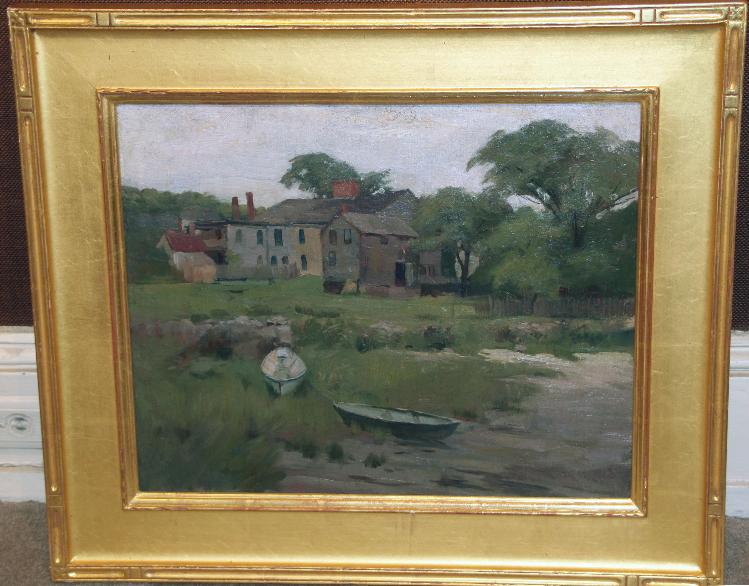
The painter leaving clues here is Arthur Wesley Dow.

The marvelous love can be seen in the way God guided his hand to fill the space on this canvas with beauty.

What marvelous love in the way the colors blend to form one world. And give us one common sky.

That common sky is a clue.

What kind of exhaling of the trials of a life took place in the homes in the foreground?

How long had the folks who lived in those homes known each other?

How many days and how many times had they looked out their windows. Saw a neighbor walking down to the swampy bay. Stopped and face to face, looking in each others eyes, got the story—and then both laughed in the common love of knowing that no one person knows the full story of whatever tiny moment of today’s pain is front and center. Laughed together to cook up some drama. But then paused, and looked up as pinpricks of pain faded in a blink in the marvelous love of that one common sky.

No one child of God knows who God is or what he’s up to.

Where had those boats been? What kind of foreign lands? What were the stories that the people from the houses told when they came back from their journeys?

What were the songs running through their minds as they pulled the boats up from the swamps and trudged up to the lights of the homes?

“The water is wide
I can not cross over
And neither have I wings to fly
Give me a boat
That can carry two
And both shall row
My love and I”

Did they see their songs as answered prayers?

Do the clues the artist leave help us make peace with all we don’t see?

Because the world has no idea who God is or what he’s up to.

In knowing we never know all of it—are even the most calcified expressions of religious beliefs accepted? If Jesus walked the dusty Afghanistan roads of death, could he really be a Chaplain in the Taliban Army?

Were the four sides of Abraham’s tent really left open so his children could enter from any side blown in by the same hot desert wind?

Are the curdling blood screams of bodies trying to stand up tall given rest? Is fear of the other stilled? When all we have to hang on to are clues?

Can we find serenity under the unified sky?

So that the marvelous love can soothe even the most savage of pains.

In better times, my wife and I would be driving through endless green fields under a great lakes sky in the empty middle of the Door County Peninsula. We’d come to a cornfield waving crossroads. Every single direction would look exactly the same. And then we’d turn to each other and say,

“All we know for sure is that we know nothing.”

Then we’d just pick a direction and drive.

And in driving through the fields, I remember the sky.

Like the unified sky the artist left us in the painting. The clue from the artist.

What marvelous love.

Posted in Uncategorized | Comments Off on What Marvelous Love

Officers Eat Last

Head slumped down hidden inside the scraggly beige down coat that is her only real home. She shuffles past our house walking north every morning.

No one sees her face.

Like a burned out barren asteroid with the last vestiges of a trail being unfathomable sadness; she blends with the grey winter sunrise. I have no idea where she goes everyday. But that rolling trail of sorrow reverberates out from somewhere inside the coat like a cry of stomach twisting pain that no one ever hears.

She deserves a story. At least a name. So call her Cassie. And remember that it wasn’t always like this for her. Crossing Grace and trudging silently up Hermitage, she passes the first 5 little houses, once home to factory workers, crammed full of kids. The Irish on the south side of Grace. The German to the north. The men listened for the whistles at the old Abbott Drug Plant or the Choir Robe Plant or any one of the other dozens of manufacturers that lined the train tracks of the Ravenswood corridor. The women swept the sidewalks out front where Cassie now walks.

Now these factory houses start at half a million. Still standing, some filled with frost free refrigerators unimaginable to those women who swept the sidewalks, who took a pack lunch with the kids to Wrigley Field on Sunday afternoons after church when the men could rest. Downstairs in the basements of those little factory homes; the hardwood beams from the northern Wisconsin forests still supporting these little homes, now with few or no kids.

Of the first 5 houses Cassie trudges by, 3 of the 5 men are out of work. Hard work, education, experience—especially experience—not being enough. The Abbott Plant a yoga studio. The Choir Robe factory being condos. And even cutting the grass being work that is unavailable to the people who live in these houses where the Wisconsin hardwoods anchor the passing of good times become hard times.

Cassie would know the hardwood trees where those beams started life. The forests of Northwest Wisconsin. The cherry farm off Sturgeon Bay. The winters. Sometimes when the wind blows fierce and as Cassie walks she smells the moraines left millions of years ago when the glaciers came through and sculpted the Great Lakes, the Door Peninsula shining brilliant promise in the light of bare trees, a white church on a hill overlooking a bay in a town called Ephraim.

The curve of the shoreline made splendid by the sun. Their tiny little farm, before he left for green jungles of rice paddy water and snakes on the other side of the world. The letters about the men. The way the shooting pains started in her legs, then the sharper pains, but she still kept waiting because the letters kept her going. “You’d eat what?” She’d write back. Twisted inside with the worry that he wasn’t taking care of himself. He just thought about the men.

Writing back about the men, and telling her, that no matter where they all were in that jungle, what really mattered was that “officers eat last.”

Officers eat last.

Those were the last words of his she ever read before she got the telegram.

And the farm. The little farm. No room for little cherry farms. Not anymore.

So she came to Chicago. To find work.

Like people have always come to Chicago since the time when, as the poet said, the first white visitors “slept till noon and then scolded the Indians for being lazy.”

Now in Chicago, no one with an ounce of sense would ever mistake Cassie for lazy. As the times get worse and the clouds of blame drift and wrap their smoky haze around those least able to take care of themselves, and those who have search desperately to find a way to blame those who have the least; Cassie’s daily walk is 8 miles. With leather like paper on the soles of her shoes.

At days end, Cassie’s walk back down south takes her along Hoyne Avenue. Like Hermitage, the kind of quiet street where her heavy heart can feel a trace of calm.

Passing by a cross street in the shadow of the steeple, she doesn’t know it’s the block where the man who was almost governor of Illinois lives. But something in her makes her burrow even deeper inside that down coat that she has no money to clean.

She looks left and sees the neighbors on this street talking on the sidewalks. She sees portable basketball nets left out on the sidewalks even when she walks home in the dark. Kids shoes and wagons and bicycles littering the block. Once she passed by and saw yellow crime scene tape blocking entry to the block and heard the music of the giant F. Scott Fitzgerald party bubbling out. Had she stopped to talk she would have found that were people who lived on that shining city block of money who would be kind to her. There were even people on that block who’d make it possible for her to get a meal on a Wednesday night. A good meal. Warm. There would be a piano playing hymns, same ones she remembered from back up in Wisconsin in the cherry grove church. And after she went back out into the cold city night to keep walking, there would be people from the block sweeping the floor of the meal room. Not a lot of people. The number getting smaller every day.

Cassie knew numbers. You don’t grow up on a farm, run a farm, figure seed costs, crop yields and market prices without knowing numbers.

Numbers like this: the people who live on that block in the shadow of the steeple are within the top 10% in wealth. And the unemployment rate of that group? 3%.

And the people in the lowest 10% in wealth? What percentage of them are unemployed? 35%.

On her morning trail of dry tears up north—the people she passed were somewhere in the middle. Between the 3% and the 35%.

Course nobody talked to Cassie about numbers.

Usually no one even saw her. And no one really knew her story.

So Cassie walked.

Back down south as the winter light faded on another day of hard times.

Cassie walked.

Posted in Uncategorized | Comments Off on Officers Eat Last

What if Stories Were the Real Medicine?

If any hospital is like a damp green canvas supply tent perched on the edge of the universal war zone where we all do battle against the fading light of one last breath; then the Evanston North Shore Medical Complex would be akin to the General’s Headquarters. Saddam’s Golden Palace where American troops now walk the halls. The stately French villa bathed in a Monet sunrise where Patton or Eisenhower planned the war.

Under the towering ceilings and golden teak wood and marble splendor of the lobby reverberating with the unseen messages sent by money; the 3 of us walk out past a gleaming black grand piano that plays a homogenized Gershwin tune all by itself. Ghost fingers striking keys in technically correct soulless precision.

A fireplace circled by comfortable chairs and a high ticket carpet. No one sits to warm themselves by the electronically dancing orange flame. A uniformed doorman, as if this was the Ritz, professionally courteous greeting guests.

But buried not so deep beneath the sprawling mushroom bastion of red brick wealth adjoining this eternal war against the roar of illness and death; at the level where the boundaries of time disappear, comes forth the silver swinging doors and sickly sweet antiseptic smell of pain and the green painted halls that slither into a circular desk that says CENTRAL REGISTRATION.

I am 4 or 6 or 12 and in the weaving past the gurneys with IV tubes and old men with parched yellow skin and empty eyes; green smocked workers, nurses in white and holy men doctors in the gray coats; there is only the subdued hospital hum of my terror numbed by the fact that I’ve been here before.

And my Mom is with me.

Here on the edge of that battle against the dying of the light, my Mom is here. So I survive.

Poked and prodded and ripped and torn bleeding because no one knew what was wrong.

But my Mom is here with me. So I survive.

Then one day they injected a dye into my neck. The early days of X-Rays.

And then all these years later in this bleakest of midwinter days, I can still feel the searing freight train burning pain in every last capillary, every cell blazing in a screaming numb horror of hurt as the dye coursed deep into the wretched bottom of my little boy soul and burst out the top of my head splaying pain like bullets of molten hot rain.

I do not know how, but if you feel that kind of pain and then it stops; believing in things you can’t see becomes easy. Faith is a breeze. Not a stretch at all.

And my Mom was with me, so I survive.

The dye of all encompassing pain lights up the tumor inside me like a blazing firework next to that neighboring battlefield of death. Then the surgeons go to work.

My Mom and Dad walk the hospital halls, linoleum then, and hours and hours later, they walk in slow motion into intensive care, where a beeping sound tells me I have a heart. Its three days later and I survive.

I’m still here.

Now I sit in that same waiting room. The layers of money not fooling me at all. It’s still the same outpost on the edges of the death war against the dying of the light.

My wife is inside. Arthography and an MRI. Because a year of silent chronic, not one complaint,  pain is enough. A lifetime of dancing and then you have to stop. You still teach. But the hip stops you from dancing. For a year. And this time you can’t even blame the victim, because it wasn’t even the dancing that did it. It’s just the way she was made. No complaints, not a word. Just a shadow in her eyes and a bravery that runs beyond what I can fathom. Not one word, as money started draining like pus from a wound. And she bit her lip, then smiled. Till it was enough. And we’d just do it. So we found out that there would not need to be a new hip. But there would be arthroscopic surgery. So we came to that same room where I had felt the injection of the dye they didn’t use anymore.

Back behind walls I couldn’t see through; that same strain of medical arrogance as the chest puffed out doctor fumbled to hit the vein and was quiet and what was supposed to take 15 minutes took an hour. And the same cold blind institutional ignorance that said it was OK to dress her up in a hospital gown, complete ½ the procedure, and then walk her too fast across the public lobby so everyone who looked could say to themselves, “Look, there goes a patient.” She tells the technician to slow down, he does for three steps and then looses her request in the war haze of his indifferent mind and speeds up again.

But somehow. Here on the edge of this battle. She draws Nancy. And Nancy, the nurse, says to her, “You just squeeze my hand as hard as you can.” Somehow, someway a human connection, like a story, cuts through the pain and gets her thru it. God gives you what you need.

While out in the waiting room, swirling in a haze of long ago  pain mixed with a pain that cuts even deeper because the very breath of your life, your life’s love, is behind a wall in a hospital. And hospitals, sitting on the edge of that terrifying battle hurt people just as much as they help them. Hospitals can kill and maim. Never, ever, ever, trust a hospital. Especially this one.

Because in war, anything can happen.

And then, just as no book could ever be distracting enough, my eyes go wide as in through the door strolls my sister in law, laughing and saying, “Looks like the whole family’s falling apart huh?” A complete and total surprise.

Better than any birthday present I’ve ever had.

Her, with her own medical trials, gets herself a quick x-ray and then comes to sit with me and wait for her sister, my wife. Talking and sharing stories and making hours seem like seconds.

Talking and sharing stories. That’s all we did.

What if the stories were the real medicine? Here in the United States in 2010 as the eternal battle against that last breath mutates and multiplies with apocalyptic momentum into an all consuming fire to suck the very life from the will to just be healthy, or to get healthy if you’re not, what if that human connection of the story, remember that time when my Mom spent her days taking me to this hospital? When Nancy the nurse said to my wife, ‘just squeeze my hand’, when a sister in law became a friend because she stayed to wait; what if the stories were the music at the edges of the war?

Stories that could be heard like songs. Like when the poet Holly Near sang:

“The junta took the fingers

From Victor Hara’s hands.

They said to the gentle poet

Play your guitar now if you can

Well, Victor started singing

Until the shot his body down

You can kill a man

But not a song

When it’s sung the whole world round.”

What if the stories were the real medicine?

Posted in Uncategorized | Comments Off on What if Stories Were the Real Medicine?

A Distant Haitian Sunrise

black_cross_new_mexico_360

 Years from now, the sad eyed young woman in an orange dress, wrapped up against the Chicago cold in a blue goose down coat steps outside the Haitian Community Center and begins to walk to the water.

Every year the quiet ceremony remembering  Earthquake Day, January 12, 2010, seems to get larger. 15,000 Haitians called Chicago home back in 2010. Thousands more do now.

In the Rogers Park neighborhood, where she lives, blocks from the Center, the huddled frozen souls of the day are are just beginning to fill the streets, the rising winter sun laughing at warmth. The woman offers up a tiny smile wondering if the tropical sun of the first 14 years of her life had warmed her bones enough to make it through all the rest of her coming winters.

Somewhere she remembers fragments of that  day in 2010. The sweet, acid smell of death in the rubble of the streets. The pleading of the dogs. The piercing eyes of the rats. How she always seemed to be thirsty.

Seeing the giant ships steaming into the harbor. And then the clatter and confusion of all the different languages. Fire trucks that said Fairfax County Virginia, the honey toned drawl of the women and men inside. The sharp staccato voices of search and rescue crews with NEW YORK stenciled on the back of their shirts, a nurse wearing a blue baseball cap with a red C, just like Sammy Sosa, barking out orders in tones as flat as the mid western plains she had ridden through in the bus that brought her to this land of dancing snow.

Truth told, she’d often giggle when the snow came. Something about the snow she just didn’t quite believe,

 If you were to ask her right that moment how she got here? How she made it when so many thousands did not? She’d never be able to answer. Because she really didn’t know. So much of the months that followed after the day in 2010 being blank. So much she didn’t know.

As she walked down to the water, the icy steam from the giant Lake Michigan rising on that future January 12, she remembered her Grandmother back in 2010.

First the earth began to tremble, the beams of the old hotel came down crashing, her grandmother trapped, her ancient Caribbean eyes still strong looking head on into the very soul of the little girl gripped in fear and saying to the child: “Always remember child, you were loved. Always remember you were loved.”

Now at the shore of the Lake. Back to her present time. She brushes snow off the bench and sits down. Today she will not be at work. Today her kids will have a substitute teacher.

A teacher. How can a woman with so many holes in her memory be a teacher?

The answer is that the drawings from the kids on her refrigerator at home, the notes from parents, and the smiles on the kids face when they come into her room in the morning, little kid sighs of safety, all of those things  tell the story of what kind of teacher she’s become.

Her, a woman who still can’t remember so much.

A blast of icy wind swirls down across the beach from the north, and she digs out of her pocket a journal and a golden pen. She remembers the music played at the ceremony. Strange music. Not Haitian at all. A piece called Cavatina. But something happened when she heard it. Something shifted inside.

She looks at the pen, puts it to paper, remembers the music and begins to write.  She begins to tell her story.

“My grandmother’s name was Elizabeth. She wore a ring

speckled with real gold. And sometimes after dinner, we’d be

sitting out on the porch, I’d hear the sound of the wind in the

palm trees—and she’d let me take a turn wearing that ring.”


Posted in Uncategorized | Comments Off on A Distant Haitian Sunrise